

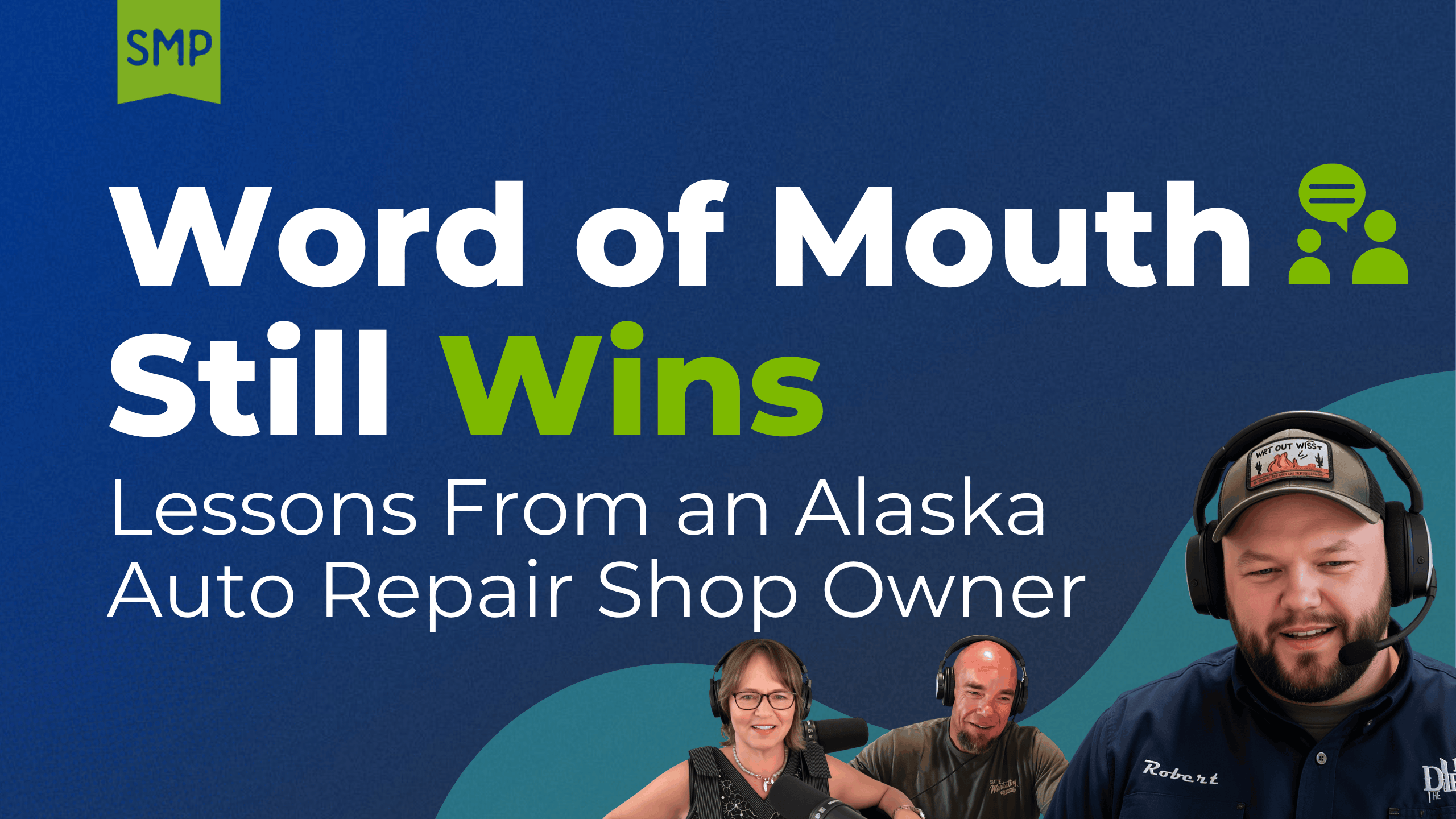
TL;DR: I sat down with Robert Wright, owner of 1023 Diesel and Fleet in Palmer, Alaska, and it reminded me that good marketing for auto repair shops isn’t a copy-paste playbook. Robert built a shop customers drive two hundred miles to reach, mostly on word of mouth, because Google ads don’t do much good for people off the grid. He hires through an honest look at his shop’s culture on social media, and he’s even used his rewards program to help an injured community member. None of that came from a template. It came from knowing his market and being real about it.
I’ve never been to Alaska. It’s on my bucket list. But I’ve watched enough of those Alaska reality shows that I probably have the wrong idea of what it’s actually like up there, kind of like how Louisiana gets portrayed in movies with swamp monsters and nothing else.
So when Kim and I got Robert Wright from 1023 Diesel and Fleet in Palmer, Alaska, on the podcast, I figured we’d learn something. I didn’t expect it to reshape how I think about marketing for auto repair shops, but it did.
I Want to Get Under Your Tools, Not Just Your Hood
Robert didn’t set out to build a general repair shop. He started fixing diesel trucks out of his garage in 2017 while working rotational shifts on the North Slope oil fields, three weeks on, three weeks off. He got busier at home than he was at his day job, so in January of 2018, he quit and went full-time with what would become 1023 Diesel and Fleet. That’s the kind of decision that either blows up in your face or changes your life, and for Robert it was the latter.
Here’s what got me. 1023 Diesel and Fleet sits about forty-five miles outside Anchorage in an area called the Valley. By Alaska standards, that’s not rural. But Robert told us his shop is the first one people hit for two hundred to two hundred and fifty miles up the Glenn Highway. Customers come from towns like Tok and Valdez because there’s nothing between where they live and his bay doors.
I’ve heard something similar from a shop owner near Fairbanks a few years back at an industry event. Most of the shops we work with are pulling customers from a ten-mile radius. This guy told me people drive two to three hundred miles to get to him. It’s not because he’s got the flashiest ads. It’s because there’s no other qualified shop in reach.
That’s the first thing Robert’s story taught me. You cannot run someone else’s marketing playbook and expect it to fit your market. A shop in downtown Atlanta and a shop outside Anchorage are not playing the same game, even if they’re both fixing brakes and doing oil changes.
Word of Mouth Doesn't Care About Your Ad Budget
Robert put it plainly that a lot of his customers are off-grid. No Facebook. No Google searches. In those pockets, word of mouth is the channel that reaches them, and it’s the one doing the heaviest lifting.
If your shop serves a similar market, it doesn’t mean paid ads or social media don’t work; for most shops, they’re some of the fastest ways to get in front of new customers, and plenty of shop owners are seeing real returns from that spend. It just means you have to know who you’re actually trying to reach. If a real chunk of your customer base isn’t active online, no amount of ad budget is going to put you in front of them, and that’s a market reality, not a knock on the tools themselves.
Kim asked Robert about this too, because she remembered something from when we ran our own shop. Boots on the ground community involvement was a big piece of how we grew, right alongside the marketing we ran everywhere else. Robert said the same thing: word of mouth is huge up there, and it’s also some of the most enjoyable marketing there is, because you’re making real connections with real people instead of chasing a click.
I’m not saying skip digital. SMP builds and runs digital strategy for shops every day, and for most markets, paid ads and social media are a core part of how shops grow. But don’t confuse having a marketing budget with having a marketing strategy. Robert’s market taught him where his best dollars go, and for him that means building trust with people first, then backing it up with the right channels for his area.
Your Reputation Is the Algorithm
One member of Robert’s community got hurt in a hunting accident, and Robert gave his customers the option to donate their rewards program points to help with the guy’s recovery. That’s not a tactic out of a marketing textbook. That’s a shop owner using the tools he already had to take care of his people.
Robert said it worked well because the man had a real relationship with one of his employees and the community knew him. That’s the kind of proof no billboard can buy. When your shop shows up for your community without being asked, your community shows up for you when it matters, whether that’s vouching for you online or defending you if something negative pops up.
I’ve said this before, and I’ll keep saying it: fix your business and your relationships before you market your shop. Marketing amplifies what’s already true about your shop. If what’s true is that you genuinely care about the people around you, that’s what gets amplified, and it beats any campaign I could build for you.
Show People What It's Actually Like to Work There
Staffing in Alaska sounds like it should be brutal. It’s not, at least not for Robert. Part of that is Alaska being a destination state, but a bigger part is what Robert has done with social media.
He told us he’s had people find his shop online, move to Alaska, and come work for him, without ever meeting him first. That happened because his team started showing the shop’s actual culture on social media instead of just posting oil change specials. People could look at his website, see what he promised, then check his social feed and see the same thing playing out in real life.
Kim pointed out something worth repeating here. A lot of shops are running a four-day work week now, offering PTO, giving their team room to actually enjoy their lives. Robert does both. When a tech is deciding where to plant themselves, they’re not just looking at the pay. They’re looking at whether the place matches what it says about itself. If your website says you value your team and your social media shows burnout and chaos, nobody’s fooled.
This is the same principle behind creating a magnetic shop culture that attracts the best team. You don’t build that by writing a good careers page. You build it by actually treating people well, then letting your marketing show the truth instead of dressing up something that isn’t there.
Know Your Season Before You Plan Your Spend
Robert’s busy season runs from June through March. Then he hits what locals call breakup season, when the ground thaws, roads get weight restricted, and work slows to a crawl. He’s already working on adding tires to soften that seasonal dip, because state law forces studded tire swaps right during that slow stretch.
Every shop has a version of this. Maybe it’s not frozen ground, but you’ve got a slow month every year, and if you’re not planning your marketing around it, you’re either wasting money pushing hard when demand is naturally low, or missing the window to fill your funnel before the rush.
This is where working with the right auto repair shop marketing companies actually pays off, not because they hand you a generic calendar, but because they help you build a plan around your shop’s real rhythm instead of a rhythm borrowed from somewhere else.
Frequently Asked Questions
My shop is in a small or rural market. Is digital marketing even worth it?
It depends on your customers. If a good chunk of them are off-grid or not active online, word of mouth and community involvement might outperform digital dollar for dollar. Don’t assume the answer is the same for every market. Look at where your actual customers are and put your effort there first.
How do I get customers to talk about my shop without asking directly?
Give them something worth talking about. That could be how you treat people, how you handle a mistake, or something you do for the community that has nothing to do with selling a repair. People repeat stories, not slogans.
What's the best way to show my shop's culture on social media without it feeling forced?
Stop staging it. Post the actual team doing actual work. Let a tech explain a tricky diagnosis in their own words. The rougher and more real it looks, the more it works, because people can tell the difference between authentic and produced.
Should I market differently during my shop's slow season?
Yes. Don’t run the same campaign year-round and hope it works. Understand what causes your slow stretch, whether it’s weather, school schedules, or something else, and build a plan that either fills that gap with a related service or leans into retention while acquisition naturally cools off.
Is paid advertising a waste if word of mouth is strong in my area?
No. Paid ads and organic trust build different things. Word of mouth earns loyalty over time. Paid advertising can still put your name in front of people who haven’t heard it yet. The right mix depends on your market, not a rule that says one beats the other.
How do I know if a marketing agency actually understands my market or is just running a generic playbook?
Ask them what they know about your local competition, your seasonality, and your ideal customer before they pitch you a single tactic. If they jump straight to services without asking questions about your shop, that’s your answer.
Marketing That Fits the Shop You Actually Have
Robert Wright isn’t running 1023 Diesel with some fancy playbook he pulled off the internet. He’s running it by knowing exactly who his customers are, what his community needs from him, and what his team needs to hear and see to want to stay. That’s the whole game, whether you’re in Palmer, Alaska, or Baton Rouge, Louisiana.
You don’t need to chase every trend or copy the shop three states over. You need marketing for auto repair shops that’s honest about your market, your team, and your season. That might mean leaning harder into community involvement. It might mean showing your culture instead of just your coupons. It might mean building a plan around your slow months instead of ignoring them.
At Shop Marketing Pros, this is what we help shops figure out: not a one-size-fits-all template, but the best auto repair marketing agency approach for your specific shop, your specific market, and your specific team. If you want help building marketing for auto repair shops that actually fits where you’re planted, book a free discovery call and let’s talk about it.
Now go fill those bays.
