

TL;DR: A waiting list doesn’t happen by accident. Advanced European and Grove Street built theirs by showing people what to expect, capping the room at 20, confirming attendance close to the date, and debriefing every single time. It started as education, not marketing, and that’s exactly why it worked. Culture, consistency, and a willingness to admit what didn’t work built the rest.
I record a lot of podcast episodes. Most of the time I go in curious. Every once in a while, I come out reinvigorated. This was one of those times.
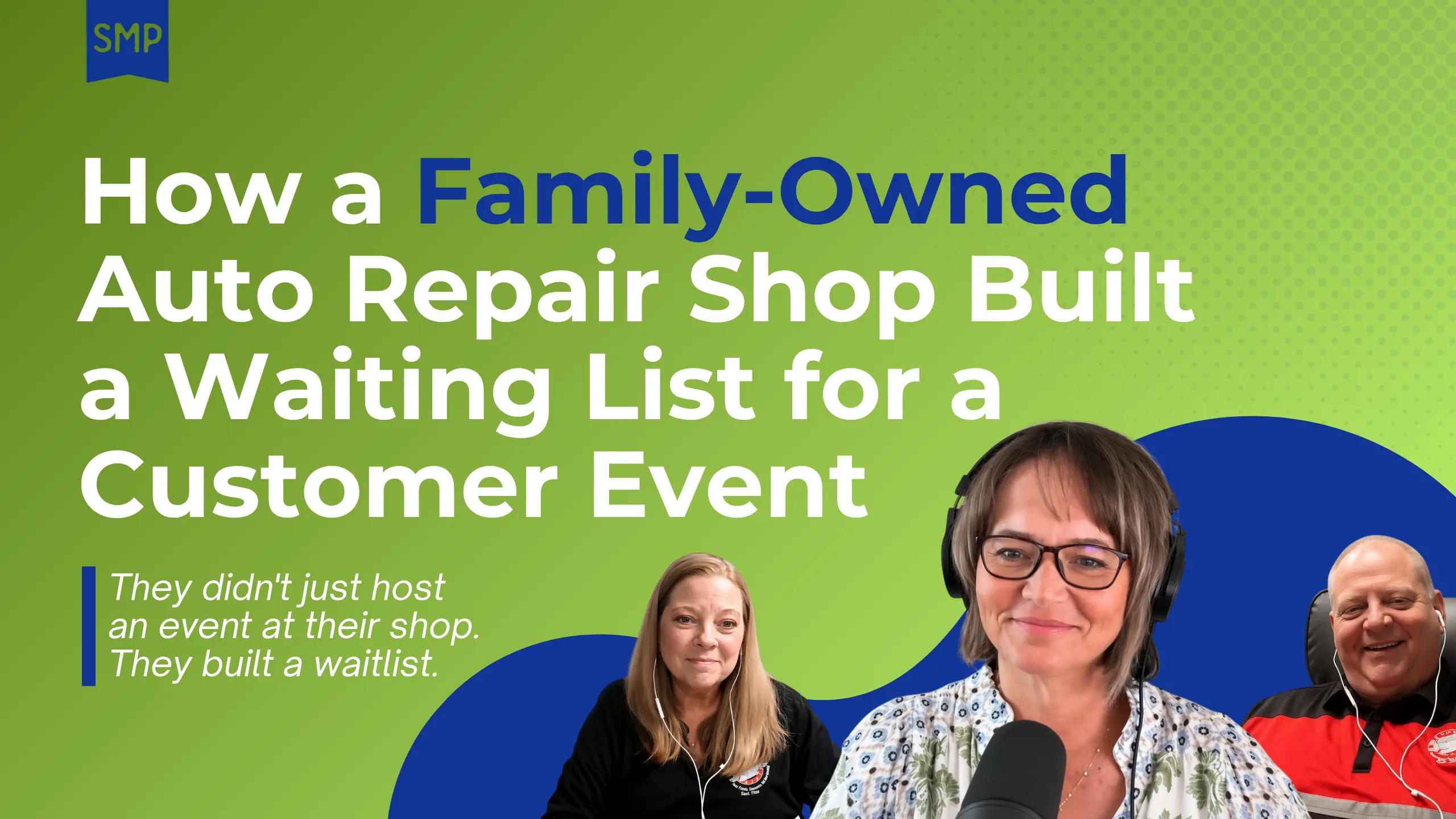
I sat down with Jean Bradley and Patrick Weidman, who’ve been Shop Marketing Pros clients for years and run Advanced European and Grove Street Auto Repair (soon to be joined by a fourth location, Trackside Auto Service). I already knew they hosted events at their shops, but I did not know they had recently filled a Ladies’ Night and had to build a waiting list. Nobody wants to register for anything anymore. So when Jean told me that, I had one question: how?
But before we get to the waiting list, you have to understand where all of this actually comes from. It didn’t start as an auto repair shop marketing plan at all. It started with an uncle named Pat and a mother named Mary Ellen.
A Lesson From Uncle Pat That Still Runs the Business
Patrick started working at his Uncle Pat’s gas station before he was even old enough to drive. Uncle Pat ran a towing operation alongside the repair bays, and one of his principles stuck with Patrick for life. AAA would pay the shop a discounted rate, maybe ten dollars, to tow a car that would normally cost thirty. Uncle Pat’s rule was simple: treat that ten-dollar tow exactly the way you’d treat the thirty-dollar customer, because you don’t know who you’re dealing with. That person might become a customer down the road, even if you’re towing their car to a competitor’s shop that day.
Do unto others as you would have them do unto you. That’s it. That’s the whole philosophy. Patrick told me it’s “an easy way to live,” and I’d add that it’s also an easy way to build a business that people trust for decades, because it removes the guesswork. You don’t have to decide who deserves your best effort because you give your best to everyone.
Choosing Events That Come From the Heart
Jean grew up watching her mother, Mary Ellen, give away her time constantly between rides to doctor’s appointments, being a Girl Scout mom, Boy Scout mom, or delivering turkeys at Thanksgiving. By the time Jean and Patrick were running the shop themselves, saying yes to community causes wasn’t a decision; it was just how their family operated.
That’s why, when the Brakes for Breasts program came across their radar, Jean called it a no-brainer. It honors their mother, who eventually passed away from pancreatic cancer after surviving multiple cancers earlier in her life. That same thread runs through their support of the Pancreatic Cancer Foundation, their involvement with the Franklin Food Pantry, and their work with the Santa Foundation, which Patrick got pulled into because his daughter, even as a young kid, insisted on donating her own birthday presents because she would say, “Christmas is right around the corner; I don’t need these.”
Here’s what I want shop owners to notice. None of these events started as marketing for auto repair shops. They started as personal connections, and the marketing benefits came later as a byproduct.
Ladies’ Night Isn’t a Marketing Event. Except When It Is.
Patrick was firm that Ladies’ Night is not a marketing event. It’s an education event. They set up stations so women can walk through and learn what a brake rotor actually looks like, what a ball joint does, and why a stolen catalytic converter costs so much to replace. Patrick’s reasoning is simple and a little protective: not every woman has someone at home who handles the car stuff, and he does not want anyone walking into a shop and getting talked down to or taken advantage of because they didn’t know what question to ask.
Something we believe at Shop Marketing Pros is that when you educate instead of sell, you’re still marketing; you’re just doing it the right way. I ran a shop myself for years that became known as the most female-friendly shop in our area, and it happened the exact same way his did: someone on the front line hears a woman say she felt nervous or unsure somewhere else, and you build your whole approach around making sure that never happens at your place.
How They Filled a Waiting List (And Why 20 People Is the Sweet Spot)
This is the part I really wanted, because “we did an event and it went well” tells you nothing. Here is exactly what Jean did to fill a waiting list:
- They pulled photos and highlights from past Ladies’ Nights so people could see what they were signing up for before committing. Nobody wants to walk into the unknown.
- They promoted on Facebook and Instagram, put up signage in the front office, and had service advisors mention it to customers in person.
- They ran a Facebook ad, but only for four days, because registrations came in so fast they had to shut it off.
- Registration went through a Google Doc sign-up form. They had roughly 25 people signed up on Friday. By Monday, they had 50.
- Because they had emails, they sent a confirmation message about a week out asking people to reconfirm, since not everyone who clicks “interested” on a Facebook event actually shows up.
- They landed at 22 attendees, with a couple of no-shows and a couple of surprise walk-ins who swore they’d registered.
They also learned the hard way that there’s a ceiling. Once you go past 20 people, it gets difficult to cycle everyone through to actually see what’s under the car on the lift, and the room can start to feel unruly. Fifteen to twenty is their sweet spot. More people does not automatically mean a better event. It just means a harder one to run well.
If you’re a shop owner thinking about your own event, notice what actually did the work here. It wasn’t a clever hook or a discount code, but rather it was showing people what to expect before they committed, staying on top of who actually planned to show up, and being honest with themselves about how many people they could realistically take care of in one night.
Getting Your Team to Say Yes
I asked how they get their team to show up for events that are often after hours or on weekends, unpaid overtime that eats into someone’s Saturday. Patrick’s answer was almost too simple: they ask, and people say yes because they want to. This happens because their shop culture is strong and has provided them with a team who cares.
That’s not an accident either. It’s the same reason their core values matter when you hire. If community involvement is baked into who you are as a shop, you stop having to convince your team to care about it. They already do.
The Post-Mortem Habit That Keeps Getting Better
Every event gets a debrief. They meet as a team every Tuesday anyway, so it happens naturally in that same rhythm, using an identify-discuss-solve format. After the most recent Ladies’ Night, the note on the list was as small as “we forgot to take a group photo.” Small notes add up. Their most recent event added a new segment on driver-assist systems, and they forgot to take the group photo.
Patrick also hands out a feedback sheet at the end of every Ladies’ Night. What could we have done better? What should we have covered? He told me almost everyone fills it out, because the people in the room are actually engaged. That feedback loop is the reason it’s his favorite event.
Not Every Event Works, and That’s Okay
I always push guests on this, because the good, the bad, and the ugly all teach you something. Patrick used to visit a local driving school to teach teenagers basic car care. Over time, he realized the kids weren’t interested, and he was mostly there so the instructor could take a break. When COVID pushed everything online, he took the opportunity to quietly retire that one. Jean’s version of the same lesson was a Teen Night where parents stood in the back getting frustrated while their kids checked out. She’d still do it again, but she’d rethink how to curate the room so it’s full of people who actually want to be there.
That’s the honest version of events marketing. Some of it works because you nailed the format. Some of it works because you were willing to admit it wasn’t working and change course.
Frequently Asked Questions
How many people should I invite to a shop event?
How far in advance should I start promoting a customer event?
Should I run paid ads to promote my event?
What if my team doesn't want to help with events after hours?
Do I need a big budget to make an event like this work?
Want Your Next Event to Fill Up Like This?
None of this started with a marketing plan. It started with an uncle’s rule about treating people the same regardless of what they were paying, and a mother who never stopped giving her time away. The waiting list, the media plan, and the four-day ad spend all came after and were built on top of something that already worked.
If you’re a shop owner looking at your own community events and wondering why they aren’t successful, the answer might not be a marketing tactic at all. It might be worth asking what your shop actually stands for first, and whether your team already believes it before you ever put an event on the calendar.
Once you’ve got that part figured out, the logistics get a lot easier to nail down. We put together an Ultimate Event Planning Checklist covering everything from choosing the right cause to running your own post-mortem. Not every auto repair shop marketing company hands one out for free. At Shop Marketing Pros, we think the best auto repair shop marketing should.
