

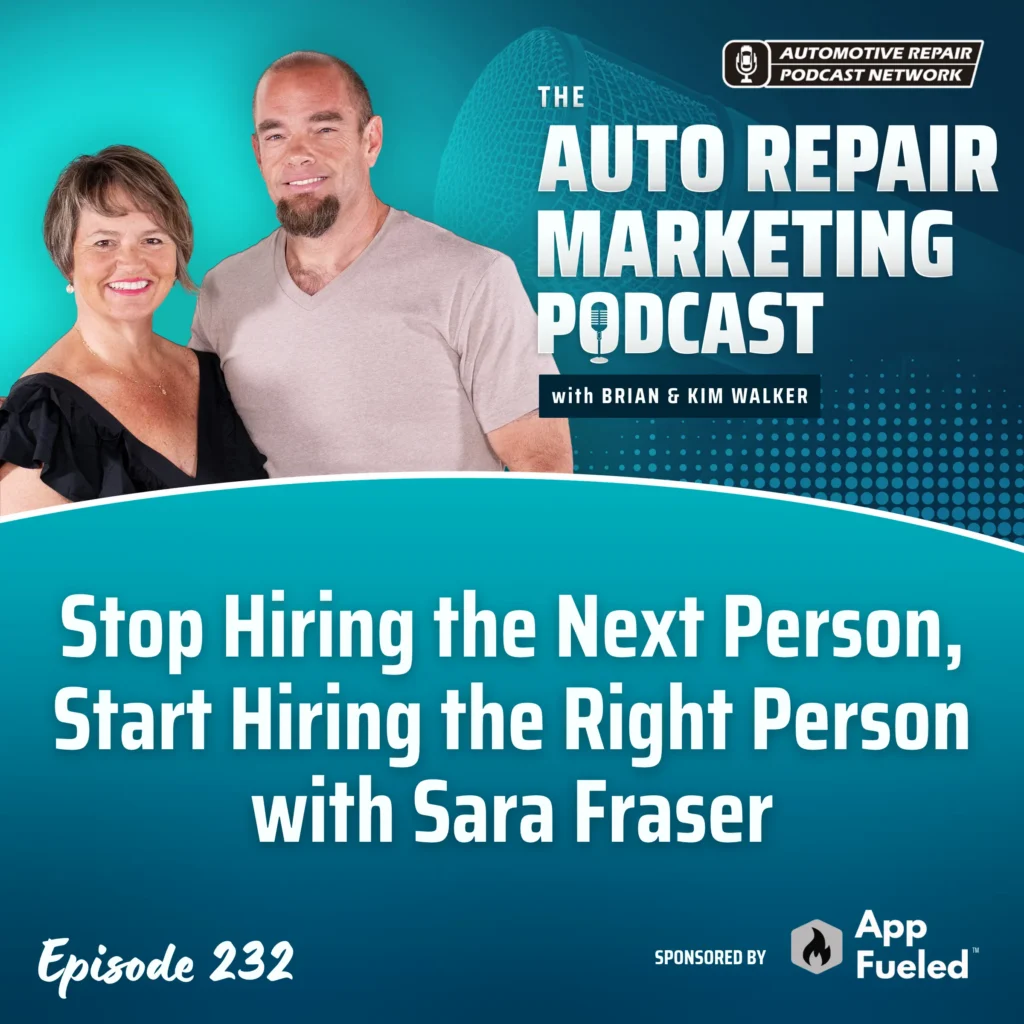


EPISODE: 232 – Stop Hiring the Next Person. Start Hiring the Right Person.
Finding great technicians and service advisors is one thing. Getting them to choose your shop, building a team they want to be part of, and keeping those people for the long haul? That’s an entirely different challenge.
And before you convince yourself that there’s simply a shortage of good people in the automotive aftermarket, you might want to take a closer look at what your shop is offering.
Today, we’re excited to welcome Sara Fraser, Vice President of Auto Ignite Management! Now, many of you in the automotive industry know Sara as the daughter of Bill Haas, a well-known industry leader, speaker, and educator. But Sara has been busy carving out her own path and making her own mark in this industry! With over 15 years of retail and management experience, including six years managing a used car sales and service center, Sara brings a wealth of knowledge in customer service, business operations, leadership, and hiring. Today, she helps auto repair shop owners find the right people, build strong teams, and create a culture where employees can thrive. She’s also an industry speaker and trainer, sharing practical insights on leadership, communication, generational differences, and strategic hiring. And that’s exactly what we’re diving into today how to recruit, hire, train, and KEEP great people!
If you’ve been struggling to find good people, or you’re tired of constantly replacing employees, there’s a lot here worth paying attention to.
Give this one a listen. You’ll walk away with practical ideas you can put to work in your shop right away, whether you’re hiring your next technician, bringing on a service advisor, or building a team that can grow with your business.
Transcript
Speaker 1 00:00:00 This is the Automotive repair podcast network.
Kim Walker 00:00:10 All right. Hello, everybody. Welcome back to the Auto Repair Marketing Podcast. I’m your host for today, Kim Walker. And I am really happy. I swear I thought I had this guest on before, but I didn’t. I have Miss Sarah Fraser with Auto Ignite Management with me today, and we’re going to be talking about tips and strategies and all the things that shop owners need to know about recruiting, hiring and retaining great team members. But before we jump into that, let me pause to give our sponsors a shout out.
Speaker 3 00:00:47 Are you ready to convert clients to members? AppFueled specializes in creating custom apps tailored specifically for professional auto repair businesses. Visit AppFueled.com to get started today. Keep your shop top of mind on the mobile device they love.
Kim Walker 00:01:03 Listen everybody, I already said this, but I’m really excited to welcome Sarah Fraser, Vice President of Auto Ignite Management. So I know that many of you already know her as the daughter of Bill Haas. But listen, she has her own path in this industry.
Kim Walker 00:01:22 She is well known as a leader, a speaker and educator. Sarah’s been carving out her own path and making her mark in this industry, and I know her dad is super proud of her. She has over 15 years of retail and management experience, plus six years of managing a used sales, car sales and service center. Sarah brings a wealth of knowledge into customer service, business operations, leadership and hiring. Today, she helps auto repair shops find the right people, build strong teams and a great culture so that these team members can thrive. She is also an industry speaker and trainer, sharing practical insights on leadership communication with our good friend Tracy Capriotto generational differences and strategic hiring. She’s a self-professed and very proud millennial and that’s just awesome. But look, we are here to really focus on the people part. So Sarah, thank you for joining me today. I apologize, I thought I already had you on, but real excited to spend some time with you today.
Sarah Fraser 00:02:30 Oh, thank you so much.
Sarah Fraser 00:02:31 I’m really excited to be here. And I mean, anytime I get to see you at a conference and catch up is always a good time. So yeah, excited to share a little bit about what we’ve been doing and if that can help some people with struggles that they’re having and hiring. You know, I’d love to be able to do that. It’s not everyone’s favorite thing to do. There is a lot of stress involved. And yet when it comes to my team and I, it’s our favorite thing to do. And so we can help. We would absolutely love to do that.
Kim Walker 00:02:56 I love that. Do you operate on EOS?
Sarah Fraser 00:02:58 No. I’ve read one of the books there on my very long TBR list, but I have not gotten through them yet, so.
Kim Walker 00:03:07 We use the disc Tony Robbins disc profile, but we have started implementing the six Working Genius assessment as well. And that’s that’s one of the tools in the EOS toolbox, if you will. So that’s why I was asking, because I would love at some point for us to talk about, do you utilize any of those types of things? The disk is more like personality, whereas the six working genius is how you work and that sort of thing.
Kim Walker 00:03:34 And so you talked about how some people just aren’t geared or made for like that whole recruiting or interviewing and you know, that that piece of it. So many of our friends in the industry who are shop owners were technicians first, right? And then suddenly they’re business owners and they’re like, wait, now I have to do HR and I have to do all this other stuff. So first talk. For the people that maybe don’t know you. About how long have you been in the business with your dad and then you all rebranded. So and I’m sure you had some leadership in that just knowing, you know, you have your own things to bring. Talk a little bit about the history and adding this piece into your business.
Sarah Fraser 00:04:18 I’ve been with the company, actually, it was just my anniversary last week, so it has been eight years, which feels wild because I think it’s just flown by. And prior to that, I was working in a shop for the six years prior to that. A lot of people think my dad is what pulled me into the automotive industry, but that’s not true.
Sarah Fraser 00:04:33 I ended up there like a lot of people, completely by accident, and was helping my mom find a car. And the guy who owned the shop was friends with my mother in law, and so she recommended we go there. All of a sudden we’re buying this car and I feel like I’m on a job interview. I had just recently left a job. I had just gotten married, like. Didn’t really know what I was doing, where I was going, and he was just looking for a part time somebody to come and help answer the phone. I mean, he was a one man shop. And so I was like, you know what? I know a little bit about the automotive industry. I grew up around it. You know, it was just like a part time for now kind of a thing, right? Until I figure out what I’m going to do. Which of course, turned into a full time job that I stuck with for six years, I got to watch this one man shop grow into a 15 person operation.
Sarah Fraser 00:05:18 We took over the building next door to us. We, you know, hired sales managers and finance managers and service advisors and all of that. So I really got a firsthand seat in watching a shop expand and grow. And then I would go and see my dad do what he was doing. And so my dad lives in Texas. I live in Wisconsin. If he was speaking at an event in Chicago, I’d go down to Chicago and see him speak, and we’d hang out, and I would get to see this side of the industry at conferences, you know, and these shops that were really elevating what they were doing and the connection and the community that was happening there. And I just felt this drive to be part of that, but I didn’t know where I fit in that right. My dad was a one man company. He’s a business coach. Like, that’s not my strong suit. That’s not what I do. I’ve been in the industry for six years at that point, but was just really not sure where I fit into that.
Sarah Fraser 00:06:06 And eventually what happened is I joined him just to help his shop clients that he was coaching with their social media, which I don’t even do that anymore. It’s not even something I do. I recommend people talk to you and much more qualified people than me to do that, but it was kind of my foot in the door. I knew enough to help out with that. We were helping a shop with their social media, and they were looking to hire a service advisor, and they were really struggling. And I was chatting with the shop owner and I said, hey, can I see your job ad? Like, what does that look like? What are we? You know, where is this directing them to? And so they sent it to me and I said, how would you feel if I rewrote this? I post it for you. I’ll do a couple preliminary interviews and just see what happens. And they were like, you would do that. And so prior to me working in a shop, I had been a store manager.
Sarah Fraser 00:06:53 This is going to age me, but I had been a store manager for a Blockbuster Video. So all the under 20 is like Blockbuster Video. So I worked there and I had done a lot of the like hiring and firing and all of that being a store manager. And so I helped the shop, we found an advisor for them, and I just fell in love with the process. And so I kind of accidentally figured out what I was supposed to be doing. And everything that I had been doing prior set me up to be in a really good position to do what I do well. And so it started very organically, our hiring program, and was something that Bill and I were doing. It was really just something we did for shops who were already in service with us as coaching clients. If they were needing help hiring, we would help with the job ads and the interviewing and all of that. And I did a webinar a couple years back on hiring practices, and a shop owner reached out to me and he said, hey, you know, I work with a different coach, but like, would you help me hire? And I thought, sure, like why not? And I think that was probably five years ago now at this point that we really started this.
Sarah Fraser 00:07:53 And today we have a full team that is solely our hiring team. Everybody on our team comes from the industry except for one of us, and his background is in stage management for theater and restaurant management. So like people processes, all of that. He’s got, you know, it’s just really been a very cool, organic thing because I remember for years going, I know I want to do something different, but I don’t know what it is. I don’t know what my skill set is. You know, I didn’t go to college. I went for a year, but I never went and got a degree or really knew this is what I’m going to do with my life. And I definitely never thought I was going to take over my dad’s company someday. I never thought I was going into the automotive industry, so things just worked out and it’s been a really fun adventure and we just love what we do. We’re continuing to grow. And yeah, so it’s been a lot of fun for us to to also take that thing that’s really stressful and hard for somebody else and take it off their shoulders.
Sarah Fraser 00:08:46 And it can be stressful, but it’s also really rewarding when we do it right.
Kim Walker 00:08:50 Yeah, for sure. And especially in this industry where, listen, I’m not saying it’s not true. It’s definitely true. However, I think that too often I’m going to say we all we can easily trap ourselves into the there are no technicians like it’s the shortage conversation. And yes, there is okay. Again, I’m not saying there’s not. There is for sure that shortage because for so many years, a generation or two heard my daddy was a blue collar worker. He was a boilermaker, he was a welder. But my family was like, don’t be a plumber, don’t be a mechanic. Don’t be a this, don’t be a that. Go to college, go to college, go to college, go to college. Well, you can only say that for so long before you run into. Well, now we have a shortage. Right. I’m not saying that’s not true. It’s definitely true. But we are what we think.
Kim Walker 00:09:50 And so I want to first and this is not even, like really doesn’t have anything to do with recruiting or, you know, the tips and the strategies. But just from that viewpoint, that perspective, I know that you have clients who are coming to you saying there’s a shortage, there’s a shortage. How do you speak to the shop owner who has that struggle in their mind of, I’m never going to find a great technician because there’s a shortage. How do we get over that?
Sarah Fraser 00:10:20 I like to think that there’s not just because we’ve hired a lot of good people, you know, there are people out there, we’ve hired a lot of them. And it’s really about, are you the kind of shop that’s going to make somebody want to come and work for you? And are we meeting the expectations of today’s workforce? And I think that’s where we miss the mark a lot. I still get shop owners who reach out to me and I’ll start asking, you know, some things and what their schedule is like.
Sarah Fraser 00:10:47 And we’re looking at either a six day workweek or a 45-50 hour workweek. And that’s one of the number one things people are looking for is work life balance. And so when you’re looking at working 50 hours a week that doesn’t check that box, that’s not an exciting opportunity for them. You know, having to wait a full year to get some PTO. Not a very exciting opportunity, not a reason to leave a job you’ve been at for a while and maybe have built that up. And now you’re going to go start over at square one. And it’s a lot of things beyond pay. Like, yes, pay is important, but it’s a lot more about training, education, growth opportunities, the benefits, health benefits, you know, work life balance, all of those things. So are we presenting an attractive place for somebody to want to come to, you know. And what does that look like? And are we understanding the expectations of the people who are looking for jobs because they are out there? They are.
Sarah Fraser 00:11:37 You know, I talk to them all day, every day. I have a calendar full of interviews. So, I mean, there are people looking for jobs.
Kim Walker 00:11:44 Well, and it may just be that maybe it’s not necessarily a shortage, but they’re already working. And so you to your point, you have to have an attractive offer or an attractive place. The grass has to look and be greener over there. Is that why you think so many shops are struggling to attract good candidates? What can they do differently?
Sarah Fraser 00:12:10 When we first work with a shop, we have a questionnaire that we have them complete. You know Tania Haines pretty well. She’ll tell you it’s a thousand pages long. It’s not. It’s only about ten, but it is long, right? It’s very detailed and it goes through basics about the shop. Right. How many bays is it heated. Is it air conditioned? Those kinds of things. But it also gets into the culture and the leadership style. And how have you handled past employee emergencies? Have you ever made changes based on employee feedback.
Sarah Fraser 00:12:39 What is your growth and training plan look like? You know what is the first 30 days look like for a new hire? And we get all of that information and we try to pull the really unique culture pieces out and highlight that in their job ads. So, you know, whether it’s taking the whole team to training events once a year, whether it’s, you know, open communication, team lunches once a week, the training and growth opportunities, all those different things that really set them apart. And this is the one thing I like to tell people when you’re writing a job ad is you can’t tell somebody you have good culture. Like you can’t say, come work for us. We have a great culture. You have to show it, and you have to show that with those examples, whether that looks like we have lunch together on every Wednesday or we do this, this and that together, but you really have to have the examples that back that up and make somebody go, oh, wow.
Sarah Fraser 00:13:28 Like, okay, that sounds like something I’d be interested in doing. It’s the same thing with saying, you know, we treat our team like family. You really can’t say that anymore. It doesn’t mean anything. It’s so overused it holds no weight, and some people really don’t like their families. That’s not really an exciting thing for them, right? So when we’re writing that opportunity to really sit back and analyze, what do you do that’s different? And that sets you apart from all the other shops in your area. And I think because we’re so in it, we don’t often think about the little things that tech or that advisor who’s looking are big things. If you have a well-lit shop that’s huge for a tech, including that in your job ad that your shop is well lit. Like that’s wow. Including like if you’ve got all the fancy scopes and things, you know, listing that what those tools are that are available, listing the training that’s available. Like, you know, all of that stuff that really is more than just I’m looking for an attack.
Sarah Fraser 00:14:22 I’m looking for a, you know. Da da da da da. But like, actually painting the picture of what your shop is like, how it operates and allowing them to see what that would be like to work there and why that’s even worth a conversation with you.
Kim Walker 00:14:35 You talked about social media a little while ago, and it’s like beating people in the head saying, like, there are some people listening who are doing a great job at this. We’re not talking to you. Okay. Hang tight. We’ll give you a good nugget in a second. This might not be your thing. Some people are doing a fabulous job with their marketing, their social media. But I say this all the time. Your marketing is attracting clients, but it’s also attracting your next team member. And too often I hear a shop owner saying, I don’t know what to post. And I’m like, if I just walked in your shop and spent five minutes, I could come up with 100 posts, like just looking around.
Kim Walker 00:15:18 And so I love that you said you have to put some meat behind what you’re saying. Right. We have to walk the talk. We have to say what you want to say, but you have to back it up. And so let’s shift the perspective a little bit from the shop owner to the technician or the service advisor or the team member. What are you hearing from those team members? The people you’re interviewing? I always say that when I’m interviewing someone, it’s a two way interview. They should be interviewing me as well because when I want the right fit, I want the right fit for me, but I want the right fit for them. And that’s how it’s part of what’s going to keep them there. But you’re talking you just said you have interviews all over your calendar. What are you hearing from the technicians or the service advisors, whoever it might be? What are they looking for? What do they want? Why would they leave a job to go somewhere else?
Sarah Fraser 00:16:14 That’s a great question.
Sarah Fraser 00:16:15 And that is a question we ask on every preliminary interview is when you’re looking for this next job, what are the three most important things you’re looking for? And typically what we hear is things like room for growth like growth opportunity training, education, communication. I want a place that actually communicates that where I feel like I’m part of the team, where my value is seen. A lot of what they tell me is more culture focused is more, you know, I want to be part of something. I want to be, you know, I don’t want to be micromanaged. I want to be trusted to to know that I bring the level of skill that I have. You know, if that’s the stage of their career that they’re at or if they might be a younger tech, you know, I want the opportunity to do more than just oil changes all day, every day. I want the opportunity to get to learn more things. So we hear a lot of that. We hear a lot of things about benefits, right? Health benefits, those kinds of things.
Sarah Fraser 00:17:10 I think it’s funny to point out that when we ask this question, very rarely is pay even mentioned in those top three things. And if it is, it’s usually the last thing they tell us. Like that is not what’s driving their decision at this point. It’s really is this going to be a place that I want it? Longevity. We hear that a lot somewhere. I want to stay for a really long time. And we see these resumes where they’ve been at this job for eight months, this job for a year, this job for seven months. And that’s a struggle for us when we have a candidate like that who we feel really strongly about. But a shop owner looks at that resume and goes, oh, they’re a job hopper. I don’t want to talk to that. And it’s like, to us, okay, yeah, that does look like you’re a job hopper, but I still want to have a conversation. I want to know why. And a lot of times it’s they haven’t found that home yet.
Sarah Fraser 00:17:54 They haven’t found the shop that is going to take care of them, that values them, that, you know, they’ve maybe had some really bad experiences. And we’ve heard a lot of that from people I talked to that have just been a little bit burnt by other places and are a little bit scared of like, is this place actually gonna do what they say they’re going to do? So we hear that this is kind of funny. This was just a couple days ago. I called somebody for a preliminary interview. And, you know, I did my little intro and he goes, oh my God, you’re a real person. I said, yeah, I am. And he goes, I mean, he goes, this might sound bad, you know, but I’ve been interviewing and he goes, my last four interviews have all been AI, have not been with humans. And I was just like, wow. And he goes, yeah, he goes. It’s really frustrating because you can’t have a conversation and you can’t, you know, he’s like, you’re just trying to figure out the right thing to say so you can make it to the next step.
Sarah Fraser 00:18:45 And I was like, yeah, that’s something we hear. And I think they’re getting a little burnt out on that AI kind of thing. So.
Kim Walker 00:18:54 Well, I mean, you know, it is like the conversation you can’t get past an hour without talking about it. And I think that we all have our love hate with it. But, you know, in the hiring process, that’s just crazy.
Speaker 3 00:19:10 Independent auto repair shops get ready to transform your business with app fueled. It’s time for your professional auto service shop to have its own customer loyalty app. App fueled will build an app that launches a custom loyalty program for your shop in 30 days or less, fully integrated with your point of sale system. Bring fortune 500 level customer retention strategies to your business without the fortune 500 budget. Many shops are enjoying the benefits. Our app engages your customers with a loyalty ladder, enticing them to climb the next rung, coming back more often and spending more each visit all with your own app. Build loyalty with your customers to your brand and boost your shop’s growth.
Speaker 3 00:19:47 Get your first app in 30 days or less, all without breaking the bank. Ready to start? Let app fueled take your business to the next level. Go to Apple.com or meet founder Jeremy Glasco and book your complimentary app vision session at Apple.com. Jeremy. That’s app. For Jeremy.
Kim Walker 00:20:13 When I’m driving down the road. You know, we’re in the automotive space, so I’m just trained now to look at every single shop as I pass by. Right. And you talked about lighting and two more times than not, I see these poorly lit up, dark dungeon looking shops with their doors open and I’m like, I don’t know how in the world technicians can work in the intricate little areas of an engine where it looks like there’s no lighting or just terrible lighting, like they think that they just open the bay doors and the sunlight is enough. They literally the lights weren’t even on. But then I go to these conferences and I hear, like you’re saying, I’ll hear conversations about texts talking about how inefficient they are because they can’t see or, you know, whatever.
Kim Walker 00:21:10 So I just thought it was neat that you said that. And I was kind of bouncing around because I want to say as a customer, and I’m totally calling Bryan Walker out right now because we’ve been having fun. My car was in the shop last week for maintenance work, and it’s just because, like, he’s working on his project stuff, you know, he’s doing what he wants to do. And if he starts working on my car, then he can’t do the fun stuff with his projects that he’s working on. So he’s the one. He was like, just bring it to Shane because there’s a guy here who owns a shop who actually was Brian’s mentor when Brian was first a technician, and he owns his own shop, so he made fun of Brian. When we dropped the car off, he was like, you bringing your car to me for maintenance work. So we had fun with that. But yeah, the lighting, it’s just things that people I think we tend to, like you said, automatically go to pay.
Kim Walker 00:22:06 We automatically think about benefits, but the tools, the equipment, the lighting, the all those other things matter as well. We talked about how to make your place stand out so that you’re attracting. Well, now you’re to the interviewing. We know all of the, like, normal questions. I want to know if you have any particular questions or conversations that shop owners should be asking to really dig into whether somebody is really a good fit or how to find red flags that maybe are often overlooked. Do you have any thoughts on on that part?
Sarah Fraser 00:22:49 I do, but I want to touch on something before I forget, because I just remembered before when you were talking about social media and like how that’s part of attracting your not only customers but potential employees. And that’s something I tell people too, with their Google reviews, when you get a bad Google review, the people who are reading your response are people who are considering coming to work for you. So really think about that too, and you’re responding to that.
Sarah Fraser 00:23:11 But yeah, in your social media, all of that, that’s so many people we interview, you know. Do you know anything about the shop? Are you familiar with the shop? Oh, well, I’ve read the reviews and I liked what I saw. I looked at their website, I looked at their social media, you know, those kinds of things. So. Okay. Interviewing. What we do is we have a multi-step interview process. So we start with a preliminary phone interview, which is about 15 to 20 minutes long. And that first interview is just a conversation. And that’s what we talk about. Like interviewing should not be an interrogation, it should not be me just firing questions off and getting answers. You know, like you had said before, they’re interviewing you as well. I like to think about it as if I’m doing the interview. I should only be talking about 20% of the time. The rest of the time, I’m really listening and being curious and asking a lot of follow up questions, or leaving silent Space for them to add more and fill more in.
Sarah Fraser 00:24:01 Chrissie, who is our lead talent assessment specialist. Her favorite thing to say is say more about that. Like just that simple. Like giving them the opportunity to elaborate a little bit more. So that first interview we have is very conversational. We typically start out with some type of icebreaker to some kind of like, hey, what have you been working on today? Or, you know, how’s the day going for you? You know, just get to know them a little bit. Are you familiar with the shop? Okay, let me tell you a little bit about the shop and how they do things. Does that still sound like something you’re interested in, or how does that fit with what you’re looking for? We’ll talk a little bit about their past experiences, why they’re looking to leave their current job, or why they left their last job. Then we’ll ask, you know, what they’re looking for in their next job. You know what’s important to you in your next job? My favorite question to ask on any interview is if I were to meet your best friend, what would they tell me they like most about you.
Sarah Fraser 00:24:48 And then once I get that answer, I follow that up with, okay, so I’m going to flip that on you. What would your best friend tell me they like least about you? We learn a lot about people with that question. So we actually had somebody interviewing for a technician who told us, well, they’d probably tell you, I’m pretty forgetful. I don’t want to hire a technician who’s pretty forgetful. And I don’t think technicians are going to go into an interview and say, oh, by the way, I’m kind of forgetful, right? But big Red flag discovered just from that conversation. So we also learn a lot of really good green flags from, you know, what would their best friend tell us? Is that their favorite thing about them. And so that’s my favorite question to ask. And then, yeah, just a lot of really good follow up questions. Getting to know who they are, getting to know what their hobbies and interests are outside of work. Like who are they as a person? What do they like to do? What’s important to them? After that first interview, we typically have them do what we call skills inventory, which is sort of a self-assessment of, you know, their skills and abilities in that role.
Sarah Fraser 00:25:45 And then if everything checks out for what the shop is looking for, then we move them to a second interview. That second interview we do virtually through zoom. Now, for a shop owner, this would probably be when you’d bring them in and have that in-person conversation. And that’s where we do get into their skill set a lot. And we go through scenario based questions, behavioral questions, all of those things. But I don’t have a set of interview questions for a second interview, because we create those based off of what we learn on their skills inventory and on their first interview.
Kim Walker 00:26:14 Yeah, it’s very custom to each person.
Sarah Fraser 00:26:16 Yeah. Like, I’m not going to if somebody says I don’t have a lot of experience in this, I don’t want to give them that scenario. Now, if they tell me I’m advanced, I could teach somebody else how to do this. That’s a scenario we’d want to walk them through. And for us, when it comes to that second interview, if it’s for an advisor, it’s typically one of our service advisor coaches doing that interview.
Sarah Fraser 00:26:35 If it’s for a technician, it’s somebody who’s had a technical background or been in a shop doing that interview. And I don’t do second interviews for technicians because although I’ve been in the industry for 15 years, I have never fixed a car. I don’t want to fix a car. I have no business understanding the process.
Kim Walker 00:26:51 Yeah, if you don’t know if what they’re saying is BS.
Sarah Fraser 00:26:54 Right, exactly. I have no idea. So you could, you know, I could ask them these questions and they could walk me through their process confidently and I’d be like, all right, they know their stuff, only to have an actual technician be like, I’m not so sure about that. So if I end up having to do one of those interviews, somebody on my team with a technical background reviews that transcript of the interview and vets that skill before they would get moved forward. One of my favorite things to do, though, is listen to interviews. That gal who works for us, her name’s Kat.
Sarah Fraser 00:27:22 She has been a technician. She’s been a service advisor. And when some of these texts get on interviews with her, you can tell they’re like, why is this girl interviewing me? Like, what does she know? And then when she’ll start talking about things or asking them follow ups and be like, oh yeah, well, I had this situation with this and you can just kind of slowly see their minds being like, oh, like she knows what she’s talking about. Like, this is somebody who has done this role, has done this work, and just getting somebody to be comfortable on an interview because they’re nervous, they’re intimidated, you know. And I want to know who they are, not who they think I want them to be. And so that’s our number one goal is, is to have a conversation, have them be comfortable. And I think a lot of that too just comes with practice, which is shop owners are not interviewing all day every day. So they don’t quite have that skill set as built up.
Sarah Fraser 00:28:11 But yeah, I mean, I have lots of interview questions and if anyone wants to email me, I’m happy to share them. But when it comes into that, like skill set stuff, that’s really we try to make that unique to what we’ve already learned about the person.
Kim Walker 00:28:24 Is it Bill who has said that he would like invite that person and their spouse out to dinner and get to know the spouse, or getting to know the spouse opened up and seeing that dynamic of how they were together. But oftentimes the spouse would fall in love with the experience. And then really, I don’t know, pressure or persuade the person to take the job. Was that Bill?
Sarah Fraser 00:28:57 Yeah, he’s talked about that. And it’s funny, I actually just sat in Cecil’s class at apex that he was doing and hiring and retention because we we hire for a lot of his clients as well. And he was saying the same thing, you know, that’s something He recommends that you take them out to dinner, and we have a shop that they invite the candidate and their spouse or whoever to come and have lunch with the whole team, you know.
Sarah Fraser 00:29:19 So they do like a team lunch on Friday. So they’ll have that person come in and do that or a one on one dinner. I mean, you learn a lot about somebody when you break bread with them, right? You learn a lot about who they are and a more relaxed environment. And I think just opening that opportunity up to if there’s somebody else involved in making this decision of your next place of employment, like, I’d love to meet them. I’d love to answer any questions they have. So, I mean, I don’t even know that it has to be a spouse. Like it could be your best friend. You know, maybe you’re young and single and, you know, but, like, you’re still trying to figure things out. And whose opinion do you value the most? Maybe you’re just out of college and you want your parent to come with you to, to, you know, like anybody, like, is there someone else involved in this decision or who you might want to have, you know, have dinner with us that we can answer any questions for.
Sarah Fraser 00:30:07 And I think it’s great. And to me as a spouse, if my husband was looking for a job and they invited us both out to dinner, it’s just like, wow, they really care about us as people. Not just his skill set, not just what you know, his production. Like they care about us and what we’re looking for and what fits that need. And I think that’s a lot of it is really that personal connection. And what is good leadership, finding out what people need and getting it for them. Right. So being able to do that from the beginning and really set the tone of that, what that relationship is going to look like.
Kim Walker 00:30:40 That’s good stuff. Okay. So I want to talk about these emergencies where I’m actively working on building my bench. I just want to kind of have people that apply for their dream job. We don’t even have a job. And then when I need someone, I’ve got candidates I can already reach out to and say, hey, are you still looking? Or whatever it might be? How can a shop avoid hiring out of desperation? Is that even? I mean, maybe that’s a retention.
Kim Walker 00:31:14 I mean. Well, just what do you think about that? These. I’m desperate. I need to hire somebody today.
Sarah Fraser 00:31:21 Yeah. So if I get that call, I’m very honest, very transparent with the shop that we are not the type of recruiting company who is going to find you somebody this week. We have a very involved process. We have a multiple interview process. We want to hire the right person, not the next person. So we’re really not the company to work with. If you’re like, I need somebody in the next two weeks and I’ll be very honest. Our typical time to placement is 2 to 4 months. You know, depending on time of year and depending on role and area, we’re I’ll never, you know, have we placed people in less than 30 days? Absolutely. We just did. But I’ll never tell somebody like, yeah, I can absolutely get you somebody in two weeks. You know, I just I can’t predict that. And nor do I want that pressure on my team to just find somebody? You know, we want to find the right person.
Sarah Fraser 00:32:08 So that’s something I’m upfront about as well, is if you work with us, you’re not going to get a ton of candidates every month. You’re not going to get 15 to 20 candidates to review. You might only get 2 or 1, but I’d rather send you nobody than send you three people that I know are wrong and a waste of your time. The point of working with us is to save you that time and that headache, and for us to go on all the bad first dates for you and all of that. So when it comes to that desperation situation, I mean, that’s what we try to do is help shop owners not make those decisions and make better decisions, because a lot of times they’ll interview somebody and they kind of know. They know that the person’s not the right fit, but they start doing this. I think they could I think they might. I think, you know, and we try to help break that down and look at these, all these red flags and look at, you know, the actual experience they have versus what you’re telling us you absolutely need.
Sarah Fraser 00:32:59 Now is that an absolute need or can we, you know, lessen that. And that’s kind of something that’s been a conversation too, because we we really go through the skill set and what’s a preference and what’s a requirement and what does that look like and all of that. So as far as building a bench, it is a little touchy because I would hate to see you find the perfect employee and then tell them, I don’t have anything for you right now. And that’s a tough place to be in. So I think if you’re always going to be hiring, like be able to bring that person on when you find them, be ready to know that that might be an option. Now we’ve definitely found people who are like, I’m not really looking right now, but this is a great opportunity. So if something opens up in the next couple of months, I’d love to be, you know, considered. So I think always having some type of ad out something going, somebody managing that for you, somebody doing consistent interviews.
Sarah Fraser 00:33:49 So you know, like if something were to happen, you’ve kind of got the process started already. But I don’t know, I don’t think you’re going to find many people that are going to sit around for a long time waiting.
Kim Walker 00:34:01 Now we’ve hired somebody, right? You’ve gone through all the stuff. You’ve gone through all the interviews. You’ve made your choice, the hiring decision. Tell shop owners listening what they need to know, because too many people just don’t have these systems in place. These processes. What? Onboarding, training and retention. Because too many people are like, okay, we hired them. They come in. All right. Go do your job. But let’s keep them. So. Talk about what those first days, weeks, months look like and training and retention.
Sarah Fraser 00:34:36 I love this question because we’re literally writing a class right now that is you hired them now. What? And it’s that next step. Right. Because that’s where we kind of passed the baton. And we’re no longer managing that process anymore.
Sarah Fraser 00:34:47 And it is having a plan letting that person know what to expect when they come in. So you’ve made the offer. They’ve accepted the offer. Now they’ve put a two week in at their current job. So you have this two week gap before they’re coming to work for you. Stay in touch in those two weeks. Find reasons to talk to them. Find reasons to message them, get their uniform sizes, get the paperwork, send it, you know, but stay in communication. Let them know you’re excited for them to come. Can’t wait for you to be here next Monday. You know, because in that two weeks, what’s happening at their current job? Are they trying to keep that person or are they offering them more? Are they saying, hey, you know, this, that the other thing or.
Kim Walker 00:35:25 It might be miserable? I mean, they might not be trying to keep them. I love I just wanted to pause and say, that is so good because, yeah, that two week window, you’re excited they’re coming.
Kim Walker 00:35:36 And then all of a sudden they’re not okay, that’s good stuff.
Sarah Fraser 00:35:41 Right? How many times have we heard that like, oh, they accepted the offer and then they didn’t show up. Did you stay in touch? Did you know what happened? Where was the disconnect?
Kim Walker 00:35:49 So you got to retain them before they start.
Sarah Fraser 00:35:51 Retention starts in the hiring process 1,000%. It does the way that you communicate your the expectations that you set, the all of that is part of that retention. If you tell them how amazing coming to work for you is going to be, and then that’s not their experience, you know? So like being able to actually give them a realistic idea of the work they’re going to do and the environments that they’re going to be in and the tools that are available and all of that. But then also understanding, you know, when they come to work for you. Yeah, they might be a highly skilled technician or a highly experienced advisor. They’ve never worked in your shop. Things are in different places.
Sarah Fraser 00:36:26 Your systems might be different, personalities are different, and understanding that they’re probably not going to show up on day one and just fit right in, right? There’s going to have to be a period of them adjusting to all the things that are new, and really having somebody be their go to person for that first week or two that, you know, if you need anything, this is who you reach out to, you know, and having that time set aside to actually train them and walk them through things versus just throwing them in. Oh, here we go. This is what you’re going to do now, right? Like having a plan for them and then checking in at the end of the first day, at the end of their first week. How did this week go? You know, is there anything I can help you out with? Anything you’re struggling with? What do you notice that you like about this job versus where you used to work, things like that? But having that communication, you know, and not waiting 30 days to do that check in.
Sarah Fraser 00:37:14 But at the end of the first week, just. And it doesn’t even have to be a formal right. Just a quick like, hey, how’s the week been for you? Kind of a thing. So a lot of retention comes down to communication. There’s something we talk about called a stay interview.
Kim Walker 00:37:27 Oh my God. I literally this week am implementing the stay interview. I’ve never heard of that in my life until recently. And okay, so I’m going to pull your team members phrase say more about that. I’ve just literally completed my sixth one because I was like, okay, wait, I’m just going to go do it with everybody up front in the beginning before I, like, put it in place. We’re going to do it at eight months. So I would love to hear all about talk about this. This is so fascinating to me.
Sarah Fraser 00:38:04 We’ve been talking about this for quite a while. My husband is in manufacturing and his company did this I think about five years ago. They haven’t done it since, but they did it right.
Sarah Fraser 00:38:13 And he came from home from work and he was telling me about he goes, so I had an interview at work today and I was like, oh, like for a promotion. And he’s like, no, no. He’s like, they just wanted to know how I feel about my job. And, you know, he said they called it a staying interview, and he walked me through some of the things that they asked him, and I was like, well, how do you feel about it? And he goes, it’s kind of cool that they actually care about how I think and what I feel. And, you know, one of the questions they asked him was, if you were to leave our company to go work for somebody else, why would that be? What would be the reason that you would leave? And he’s got a 45 minute commute to work. So that was, you know, if I found the same job 20 minutes closer now, his company can’t move their location. But if they were really thinking ahead and wanting to make sure they were holding onto retention, they could have offered him a commuter benefit.
Sarah Fraser 00:38:58 A gas card. You know something. But if you don’t ask those questions and have that communication, you can’t get ahead of that. So what? A stay interview is a one on one conversation with your employee that has nothing to do with their performance. It is not a performance review. It is not tied to a raise. It is nothing like that. It is more so a chance for them to review us in a way. Are there any skills that you have that you don’t feel like we’re currently utilizing that we could utilize better? Is there any skills you want to learn? Is there any training you want to go to? Is there something new you would like to be doing if you were to leave, what would you know? Is there any? Have you ever thought about leaving and if so, what was the reason behind that and how can we get ahead of that? Do you feel like you have good relationships with our team? Is there anyone on the team that you feel causes friction? You know, and it’s really you have to be able though to to go into this very open minded and willing to take what they’re telling you.
Sarah Fraser 00:39:54 And not be defensive. And not because if we’re going to ask for that feedback, we have to be able to receive it, process it, and then do something with it. So you can’t just do the say interview. You also then have to follow up on what you learned. And I’ve had somebody tell me, actually, Chrisi, who works for us, when we did this with her, I think we did it probably about six months in. She’s been with us for just over a year. And she said, you know, I’d really like to teach classes someday at events. That’s something I’d be really interested in. And she just co-taught with me at AAPEX this year. So being able to like, learn that and see that happen and really create the space to have that conversation in a comfortable space.
Kim Walker 00:40:31 We talked about EOS and one of the things that EOS talks. There’s a book called The Five Dysfunctions of a team. And essentially, if you’re familiar with Maslow’s hierarchy of needs, right, there are some things you have to have before you can have the next and so on and so forth.
Kim Walker 00:40:46 And the five Dysfunctions of a team. The foundation comes down to trust. So not having trust is a big dysfunction. If you don’t have trust, you can’t have those candid conversations or healthy conflict and then accountability and owning results and all. There’s five, five different ones. And I just had a stay interview literally 30 minutes before I was talking to you. And this team member shared something. And I was like, I remember thinking in my head, there’s no way that she would have said that if she didn’t trust me to receive that feedback. And I just loved it. It was so great. And I’m taking some of the things that you just said to add in to our stay interviews. I’m purposely right now intentionally keeping my mind super short because I’m doing 38 of them to just get started, but going forward, we’re intentionally inserting it at the eight month mark for us. Like, we know that that’s a time when people start getting a little antsy and we just know that that’s an important time.
Kim Walker 00:41:54 And so I’m going to implement it at the eight month mark. But I’ve been asking these simple questions. Hey, Sarah, why are you still here? What keeps you at shop marketing prose. Right. And then I go into, okay, is there anything that could make you start thinking about leaving? And then I ask them, is there one thing we could do better to make this an even better place for you to work? And then I just ask, is there anything you were hoping I might ask that I didn’t, but you talked about? What training would you like? Or are there any skills we’re not utilizing for you? And those are great questions. I did have a team member who did share, but I think he has the gift of wonder. And so he was already kind of thinking that way. But some people don’t have that natural tendency. Would not have thought to answer in that way to these questions. So I think asking the direct question of what skills are we not utilizing? But he was able to say, you know, I’d really love to grow in this area or so on and so forth.
Kim Walker 00:42:56 So I just love that you brought up the stay interview, because I’ve had seven already, and they’ve been incredibly amazing and eye opening in a good way. Like, I love what I’m hearing. To your point, I’m waiting and I’m expecting someone to give me some type of negative feedback. I want that I’m ready and prepared for it. But it’s actually we had some churn earlier this year that I just couldn’t figure out. Like, why am I having to fire people and why are people quitting? And one thing we’ve learned is, you know, we’ve had a lot of growth, and sometimes the people that will get you here are not the people that will get you there. And, you know, part of that is you got to take ownership in getting the right people and all of that. But we intentionally wanted to make sure that we’re doing everything we can do to retain people. And in my research and my discussions with other agency owners, the stay interview was a big thing. The six working genius.
Kim Walker 00:44:01 We also do an Employee Net Promoter Score survey every quarter. So anyway, I love that you said that. All right. Before we wrap up, do you have any last words or, you know, is there one thing that you can tell people to improve in their people process this month, like something actionable to do right now, right today? Any last things that you want to share?
Sarah Fraser 00:44:27 Oh gosh, that’s no pressure. Right. One last thing, I think to really take a step back and look at your business from fresh eyes and what sets it apart and what would make somebody really excited to come work for you or if you’re doing the same interview. Learning what your current employees really enjoy about working for you and working that into your hiring process. How do you highlight that in the opportunity? How do you show that in your job ad and look at your if you’ve had a job ad running that you’re just throwing money at and not really getting anything from it? Look at the process. Something’s broken in the process, right? And a lot of times that’s just we see shops that throw $100 a day at an ad, but then they don’t look at it for two weeks.
Sarah Fraser 00:45:11 And then by the time they do, when they start reaching out to these people, they’ve moved on. So like that’s a big part in hiring is you have to be timely. You have to be, you know, on top of reviewing resumes and staying in touch with people and following up with people to get through everything and also to just not be defeated. Like there are good people out there, I promise you. There really are. I talk to a lot of them so they exist. And you know, if you need help, reach out to somebody that can help you. Even if, you know, you just have a question. You want me to look at your job? AD? You have a question about something, shoot me an email. I’m happy to have that conversation.
Kim Walker 00:45:44 Well, Sarah, to that point, tell people where to find you, how to reach out. Because look, again, we’re like you like shop owners often come from being a technician. They’re not business owners.
Kim Walker 00:45:58 They’re not HR minded. They’re not marketing minded. So we’ll do their marketing, but you’ll help them with their hiring. So if they’re in that spot, you’re talking to the shop owner who’s like, I don’t want to do this, or they have the time. They just don’t know how or they just don’t want to. Where can they reach out to you?
Sarah Fraser 00:46:14 Yeah. So you can find us at Auto Ignite Management. Com or you can email me directly at Sarah Sara at auto Ignite management. Com.
Kim Walker 00:46:24 All right. Well Sarah thank you. Great chat. Lots of great I got some takeaways I know everybody listening took something from this. So I really appreciate your expertise and your leadership in the industry and helping everybody. So thanks for being here.
Sarah Fraser 00:46:42 Thank you for having me.
Kim Walker 00:46:44 Thanks again to all of you who are listening to the Auto Repair Marketing podcast on the Automotive Repair Podcast Network. There are some other great shows on this network, and you can find them all at Automotive Repair Podcast Network.
Kim Walker 00:46:56 Com or on the super cool free mobile app, which you can find at ARPN app. You can listen ad free. Until then, tune in for another episode next week and we hope that you go fill those bays.
Speaker 1 00:47:14 You’ve been listening to the Auto Repair Marketing podcast with Kim and Brian Walker on the Automotive Repair Podcast Network. Download our exclusive podcast app at Automotive Repair Podcast Network. Com because the best conversations in the industry start here. Marketing questions? Well, the walkers have the answers. Check the show notes for their email.
Timestamps
Introduction and Sponsor Message (00:00:00) Kim Walker welcomes listeners and introduces the episode’s sponsor, App Fueled.
Introducing Sara Fraser (01:03) Kim introduces Sara Fraser and her experience in automotive leadership, hiring, and team building.
Sara’s Background and Career Path (04:18) Sara shares how she entered the industry, joined her father’s company, and developed its recruiting service.
Overcoming the Perceived Technician Shortage (08:50) Sara discusses making shops attractive to candidates through work-life balance, benefits, training, and growth opportunities.
Showcasing Shop Culture in Job Ads (12:10) Sara explains how specific examples of culture, equipment, and working conditions make job listings more compelling.
What Candidates Want in Their Next Job (15:18) Sara shares candidates’ priorities, including growth, communication, trust, benefits, and a sense of belonging.
Sponsor Message (19:10) App Fueled promotes custom loyalty apps designed to help repair shops retain customers.
Interview Questions and Candidate Assessment (22:06) Sara outlines a conversational, multi-step interview process and shares questions that reveal candidates’ strengths and concerns.
Including Family in Hiring Decisions (28:24) Kim and Sara discuss inviting a candidate’s spouse, family member, or trusted person to meet the team.
Avoiding Desperation Hiring and Building a Candidate Pipeline (30:40) Sara explains why thoughtful hiring takes time and how shops can prepare without expecting candidates to wait indefinitely.
Onboarding and Early Retention (34:01) Sara recommends staying in touch before a new hire starts, providing a clear onboarding plan, and checking in early.
Stay Interviews for Employee Retention (37:14) Sara describes stay interviews as a way to learn what employees value, address concerns, and support their growth.
Practical Hiring Improvements and Final Advice (44:01) Sara recommends reviewing what makes the shop appealing, responding promptly to applicants, and seeking help when needed.
Contacting Sara and Episode Wrap-Up (45:44) Sara shares Auto Ignite Management’s contact details, and Kim thanks her and closes the episode.
How To Get In Touch
Join The Auto Repair Marketing Mastermind Group on Facebook
Meet The Pros
Follow SMP on Facebook
Get The Ultimate Guide to Auto Repair Shop Marketing Book
Email Us Podcast Questions or Topics
Lagniappe (Books, Links, Other Podcasts, etc)