


TL;DR: Keywords in your Google reviews are a secret weapon most auto repair shops ignore. When customers mention your location, their vehicle type, and the service you performed, Google connects you with people searching for exactly that. Generic “great shop!” reviews feel nice, but don’t help visibility. Detailed reviews like, “This is the next BMW alignment availablele in Lewisburg,” put you at the top when potential customers search. The fix? Ask your regulars to include those details. Guide them, explain why it matters, and watch qualified leads find you.
Here’s the truth nobody’s telling you: Google reviews aren’t just about collecting stars and feeling good about yourself.
Most shop owners treat reviews like oil change stickers: slap ’em on, forget about ’em, and hope they do something useful. You get a five-star review, you drop a quick “Thanks!” and move on with your day. Customers are happy. You’re happy. Everyone wins, right?
Wrong.
If you’re not getting keywords in those reviews, specific details about your location, services, and vehicles you work on, you’re basically running a shop with no sign out front. People are driving right past you because they can’t find you when they’re searching for exactly what you do.
And that’s not just a missed opportunity. That’s money walking straight into your competitor’s bay.
The Key West Moment That Changed Everything
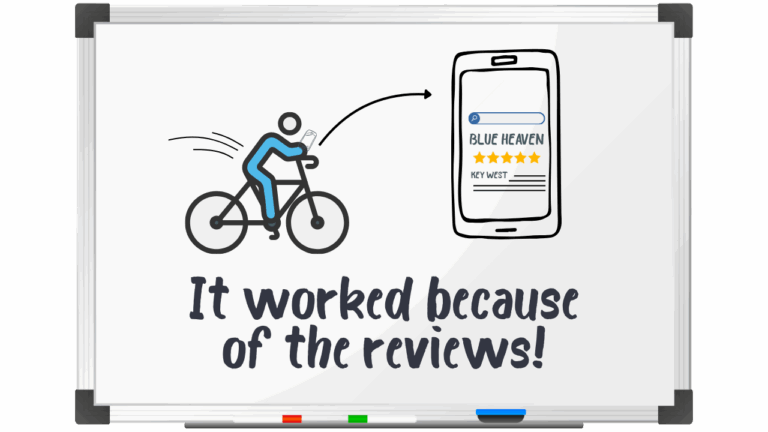
I need to tell you a story. Because this is the moment I realized just how powerful keywords in reviews actually are.
A few years back, my wife, our son Payton, and I were in Key West. August. So yeah, it was hot. We’re riding bikes around the island as we normally do when we travel, and we desperately needed to get out of the heat.
We remembered this restaurant from a previous trip. It had this incredible courtyard in the back with a canopy of trees, roosters running around, the whole Key West vibe. It was the perfect spot, but we couldn’t remember the name.
So I pulled out my phone and searched: “Key West restaurant with a courtyard with a canopy of trees.”
Blue Heaven came up first.
Now, I’ve since learned Blue Heaven is kind of iconic in Key West. But here’s the thing: it came up because people mentioned those exact details in their Google reviews. The courtyard. The canopy of trees. Even the roosters.
The very next day, we’re riding bikes again and remembered another restaurant. This one had a second-floor balcony overlooking Duval Street. Couldn’t remember the name.
So I searched: “Restaurant with a second-floor balcony overlooking Duval Street.”
Boom. The exact place came up for the same reason: people put those details in their reviews, and Google served it up like it was reading my mind.
That’s when it hit me. This is exactly what auto repair shops need to be doing.
Why This Matters More Than You Think
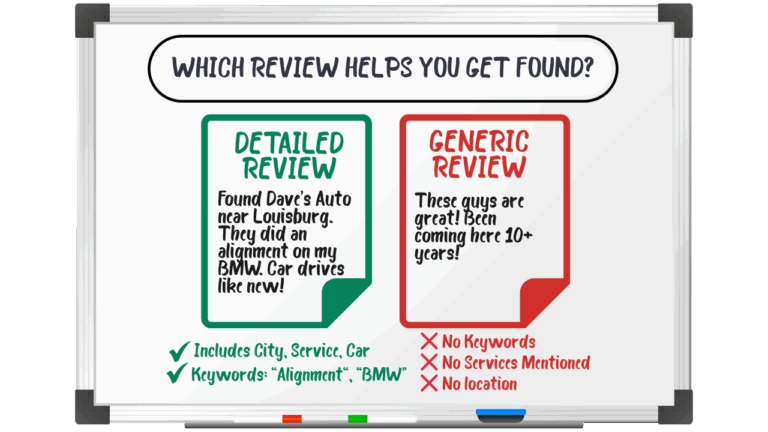
Google’s entire job is matching people with what they’re looking for. When someone types “Subaru mechanic near me” or “transmission repair in Denver,” Google scans everything about your business, your website, your Google Business Profile, and yes, your reviews to figure out if you’re the answer.
Think of it like running diagnostics without a scan tool. You can guess at the problem based on symptoms, but you’re just not going to be as effective as the guy who’s got the right equipment feeding him the exact data he needs.
If your reviews don’t include any specifics, Google’s got nothing to work with.
But when your reviews mention:
- Your actual location (city, neighborhood, nearby landmarks)
- The vehicles you specialize in (makes, models, even years)
- The services you provide (diagnostics, alignments, brake jobs, engine work)
- Your team members’ names
You’re giving Google the diagnostic data it needs. You’re saying, “Hey, when someone searches for this exact thing, send them to us.”
This is marketing for auto repair shops on autopilot. And it doesn’t cost you a dime in ad spend.
The Magic Formula: Just Ask
I know what you’re thinking. “Brian, I can’t tell customers what to write. That’s weird.”
You’re right. You can’t dictate reviews.
But you can absolutely guide people. And here’s the secret weapon: You ask them.
Most shop owners don’t want to ask new customers for detailed reviews. I get it. You don’t have that relationship yet. But if you’re like most great shops I know, your customers come back again and again. You build real relationships with them. They trust you with their cars, their family’s safety, and their hard-earned money.
It should be no problem to ask them to help you out.
Here’s what you say when you’re wrapping up service with a regular customer:
“Hey, in a couple of days, you’re going to get a request for a Google review. If you wouldn’t mind leaving one, it really helps us. And if you could include a few details like what kind of car you drive, what service we did, and maybe mention our location, that helps other people find us when they’re searching for the same thing you needed.”
That’s it. No script. No pressure. Just a simple ask.
Most people are happy to do it. Some will forget, but many will remember because you made it easy and you told them why it matters.
What Your Page Must Include
What Makes a Review Actually Useful

If you want reviews that work as hard as your best tech on a Monday morning, here’s what you need in them:
Location Details
- Your city or town
- Their neighborhood
- A nearby landmark or shopping center
- The street you’re on
“Found this place near the Costco on Route 9 in Natick.”
Vehicle Information
- Make and model
- Year if they want to get specific
“Brought my 2019 F-150 in for a check engine light.”
Service Performed
- What did you actually fix?
“They tracked down an intermittent misfire on my Audi that two other shops couldn’t figure out.”
Team Members and Experience
- Names matter. Stories matter.
“Jake explained everything in plain English and didn’t try to sell me on stuff I didn’t need.”
All of this feeds your best auto repair shop marketing strategy without feeling salesy. Because it’s not marketing, it’s just honest customers talking about their real experiences.
Don't Just Collect Reviews, Respond to Them
Here’s something most shops miss: getting keyword-rich reviews is only half the battle. Responding to those reviews is where you double down on the SEO impact.
When you respond to a review, you get another chance to include those same keywords naturally. A customer mentions they brought their “2019 Honda Accord in for brake service in Naperville.”? Your response should acknowledge it:
“Thanks for trusting us with your Honda Accord’s brake service! We’re glad we could help, and we appreciate you taking the time to visit our Naperville location. See you next time!”
You just reinforced those keywords for Honda Accord, brake service, and Naperville, and Google sees it all.
Plus, when potential customers are reading reviews, they’re also reading your responses. When they see you’re engaged, professional, and actually paying attention to your customers, that builds trust before they ever pick up the phone.
So don’t just ask for detailed reviews and call it done. Respond to every single one. It takes 30 seconds, reinforces your keywords, and shows you actually care about the people who keep your bays full.
And if you need help figuring out how to respond without sounding robotic or making it weird, we’ve got you covered with our guide on how to respond to customer reviews without losing your head.
The Compound Effect
Here’s where this gets really good.
It’s like building compression in an engine. One cylinder firing doesn’t give you much power. But get all of them working together in the right sequence, and you’ve got serious performance.
The more keyword-rich reviews you build up, the more visible you become for a wider range of searches.
Let’s say you’re in Austin. Over six months, you accumulate reviews mentioning:
- “European auto repair South Austin”
- “Volkswagen specialist near Zilker Park”
- “BMW brake service Austin”
- “Audi mechanic near Barton Springs”
Now you’re not just ranking for “auto repair in Austin.” You’re showing up for specific searches from people looking for exactly what you offer.
And those people don’t price shop. They’re looking for expertise. They convert. They become the kind of customers you actually want.
This is how you stop being “just another shop” and become the shop people are looking for.
You Can't Be Generic. You Must Be Specific.

Look, I know you’re busy. You’ve got bays full of cars, customers waiting, and a team depending on you. The last thing you need is another complicated marketing thing to manage.
But this isn’t complicated. This is one conversation with a customer. One simple ask. And it compounds over time.
Think of it like preventive maintenance. Five minutes now saves you hours of headache down the road. Ask for detailed reviews today, and those keep working for you months and years from now.
Start with your regulars. The people who’ve been coming to you for years. The ones who already tell their friends about you. They’re the easiest to ask, and they actually want to help.
Just ask them to be specific. Not generic.
Because when someone three miles from your shop pulls out their phone and searches for the exact service you provide on the exact vehicle you specialize in, you want to be the first shop they see. Not your competitor.
FAQs: Keywords in Google Reviews for Auto Repair Shops
How do keywords in reviews help my auto repair shop’s SEO?
Keywords in reviews tell Google exactly what services you offer, what vehicles you work on, and where you’re located. When customers mention specific details like “BMW alignment near Lewisburg,” Google ranks you higher for those exact local searches.
What specific details should I ask customers to include in their Google reviews?
Ask customers to mention your location, the vehicle you worked on (make and model), the specific service performed, and team members by name. These natural details boost your visibility for relevant searches without feeling forced.
Is it against Google’s rules to ask for keywords in reviews?
No. Guiding customers to share specific, truthful details is completely acceptable. What’s prohibited is writing reviews for customers or offering incentives, but asking them to include helpful details like vehicle type and service is perfectly fine.
How many detailed reviews do I need before I start seeing results?
Every detailed review helps improve your visibility, and the benefits compound over time. The key is consistency. Make it a habit to ask your regular customers for specific details in their reviews, and you’ll gradually rank higher for the exact services and vehicles you specialize in.
When should I ask customers to leave a detailed review?
Ask right when finishing service, while everything is fresh. Let them know they’ll get a review request in a few days and explain what details help ensure they include specifics instead of generic praise.
Stop Leaving It to Chance
If you’re serious about growing your shop, attracting the right customers, and owning your local market, you need to stop treating Google reviews like background noise.
Generic reviews are nice.
Keyword-rich reviews are game-changers.
They’re the difference between hoping customers find you and knowing they will.
So stop waiting. Stop assuming. Start asking for details. Guide your customers to help you help the next person who’s searching for exactly what you do.
Your Google Business Profile should be working for you 24/7, pulling in qualified leads while you’re wrenching on cars or home with your family. But only if you give it the fuel it needs.
And that fuel? It’s detailed, specific, keyword-rich reviews.
At Shop Marketing Pros, we help shops build auto repair marketing that actually moves the needle from Google reviews to full-scale content plans. If you’re ready to stop blending in and start dominating your market, let’s talk.
Book your free discovery call and let’s turn your reviews into your most powerful marketing weapon.
And remember: in everything you do, Be a Pro.
